Ragupathy's Research Group

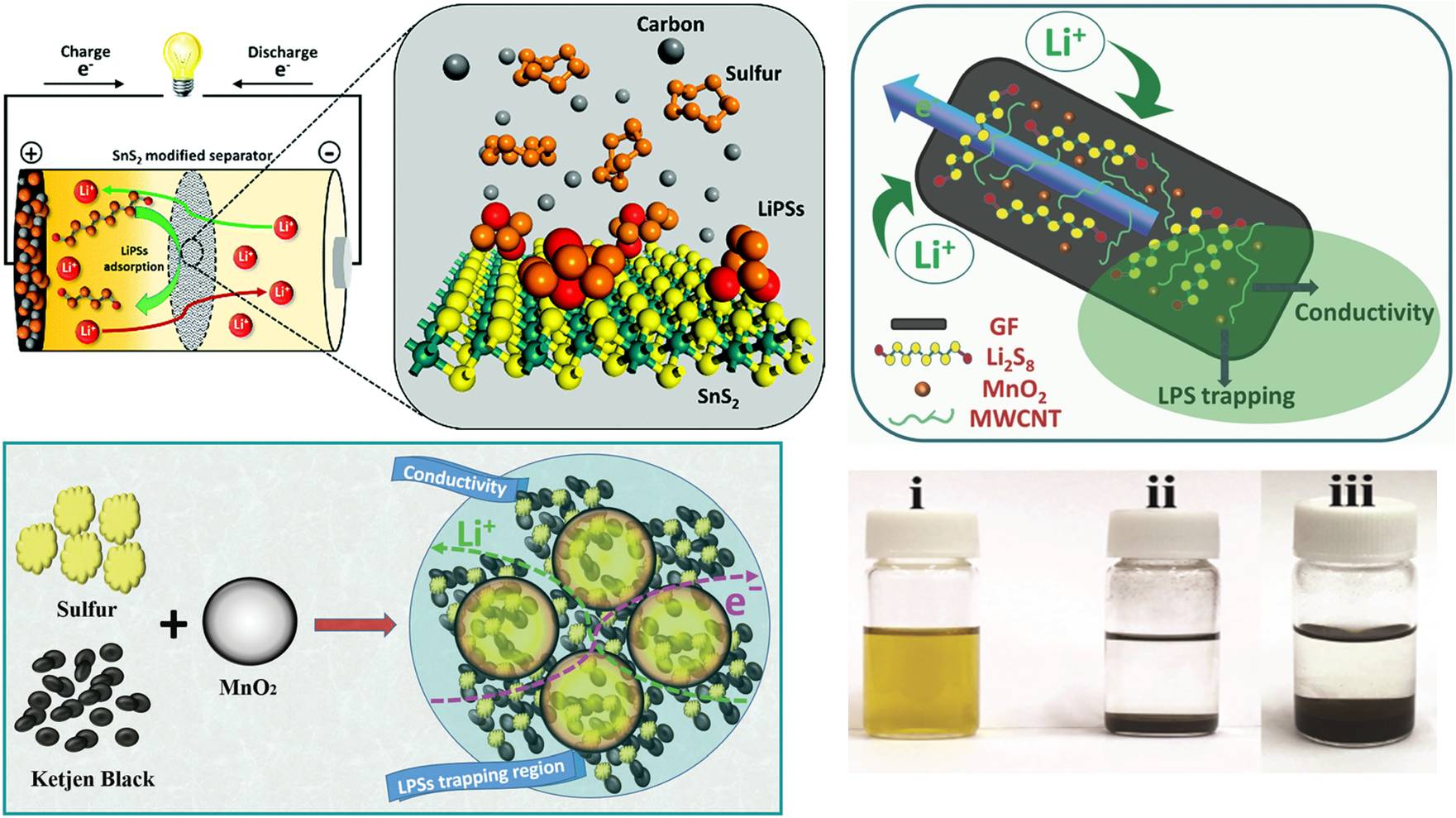 |
Rechargeable metal sulfur batteries have received much attention recently due to their high energy density (5 times higher than that of conventional LIBs). Further, sulfur batteries may represent as next generation storage systems owing to the cheaper, abundant and environmental benign nature of sulfur. However, the complete impact of metal sulfur batteries is not met due to numerous challenges such as poor electronic conductivity, polysulfide dissolution and dendrite growth of metallic lithium. Our group is engaged in addressing these challenges by developing novel electrode design, polysulfide trapping agents/additives and modification of sulfur electrodes. |
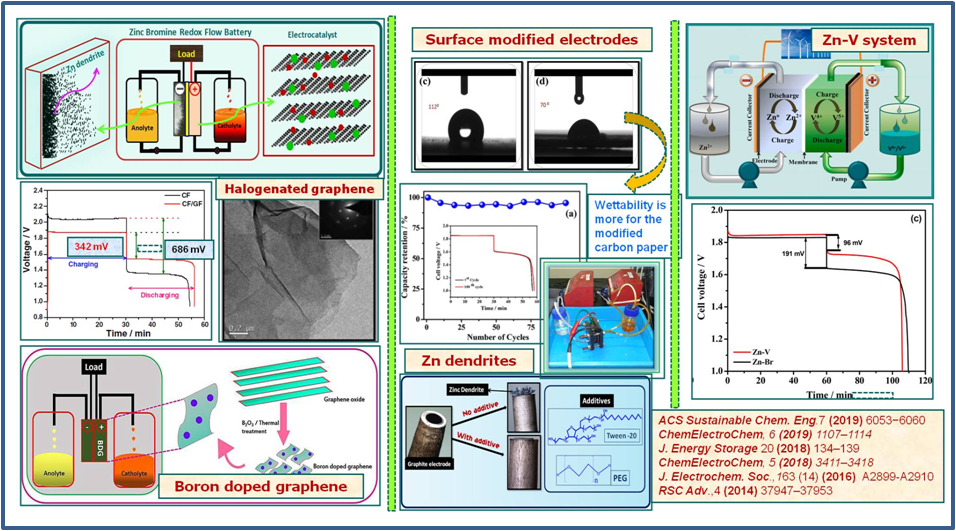 |
Redox flow batteries (RFB) are the most appealing electrical energy storage systems for the utilization of renewable energies like solar and wind due to their high energy efficiency, deep discharge ability, low self-discharge and long cycle life. A unique advantage of RFBs is the decoupling of energy capacity and power density which is not possible with the other existing conventional batteries such as lead acid, nickel cadmium, Li-ion batteries. Despite these advantages and favourable features, commercialization of flow battery has impeded due to various factors such as (i) solubility of active materials (ii) poor kinetic reversibility (iii) lack of robust elecatrocatalyst (iv) self discharge associated with active materials crossover and (iii) short circuit happening due to metal dendrites. Our efforts are centred on the development of low cost electrode materials/separators, novel electrolytes for improving the cell performance, nanocatalyst for enhancing the kinetics of the redox process. . |
 |
With the need of electrified transport in recent scenario, it is very essential to increase energy density of the battery to large extent. Metal air battery is the possible potential candidate for achieving superior energy and power density. The main challenge that limits the practical use of this technology includes the sluggish oxygen reduction reaction (ORR) (during discharge) and oxygen evolution reaction (OER) kinetics (during charging). Therefore, it is highly desirable to develop robust electro catalyst for both ORR and OER, namely a bifunctional electro catalyst. Our focus is to find the suitable bifunctional electro catalyst which easy the oxygen reduction and oxygen evolution and improving cycle life of metal air battery. |
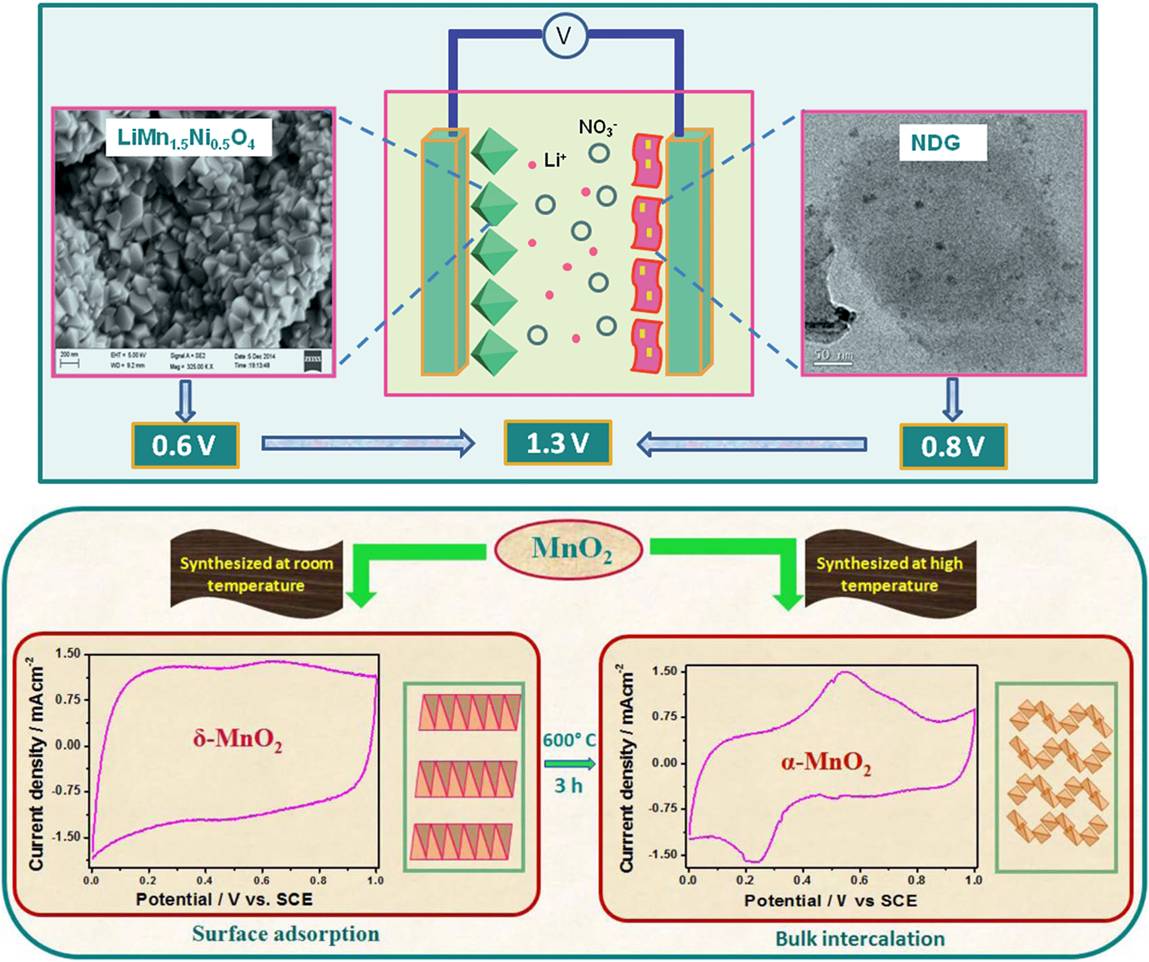 |
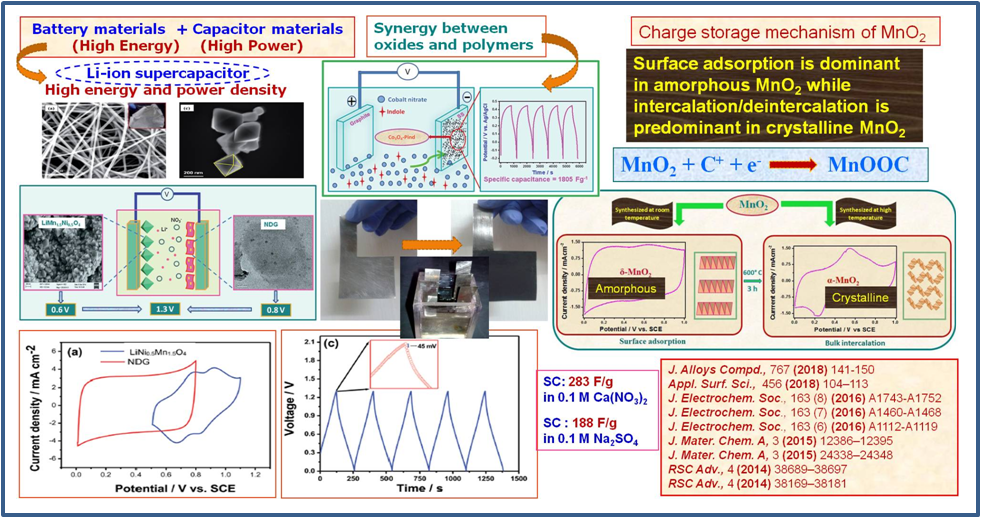
Supercapacitors are energy storage devices with high power density (quick charging) and long cycling ability (million charge-discharge cycles). They are always complimentary to fuel cells or batteries in multiple applications. However, the challenges remains as limited energy density, instability at electrode/electrolyte interface, expensive active materials, etc. Our strategy is to develop low cost, environmentally benign active materials to enhance the energy density of the supercapacitors. Understanding the factors that influence the performance characteristic of the supercapacitors is also our prime interest. |